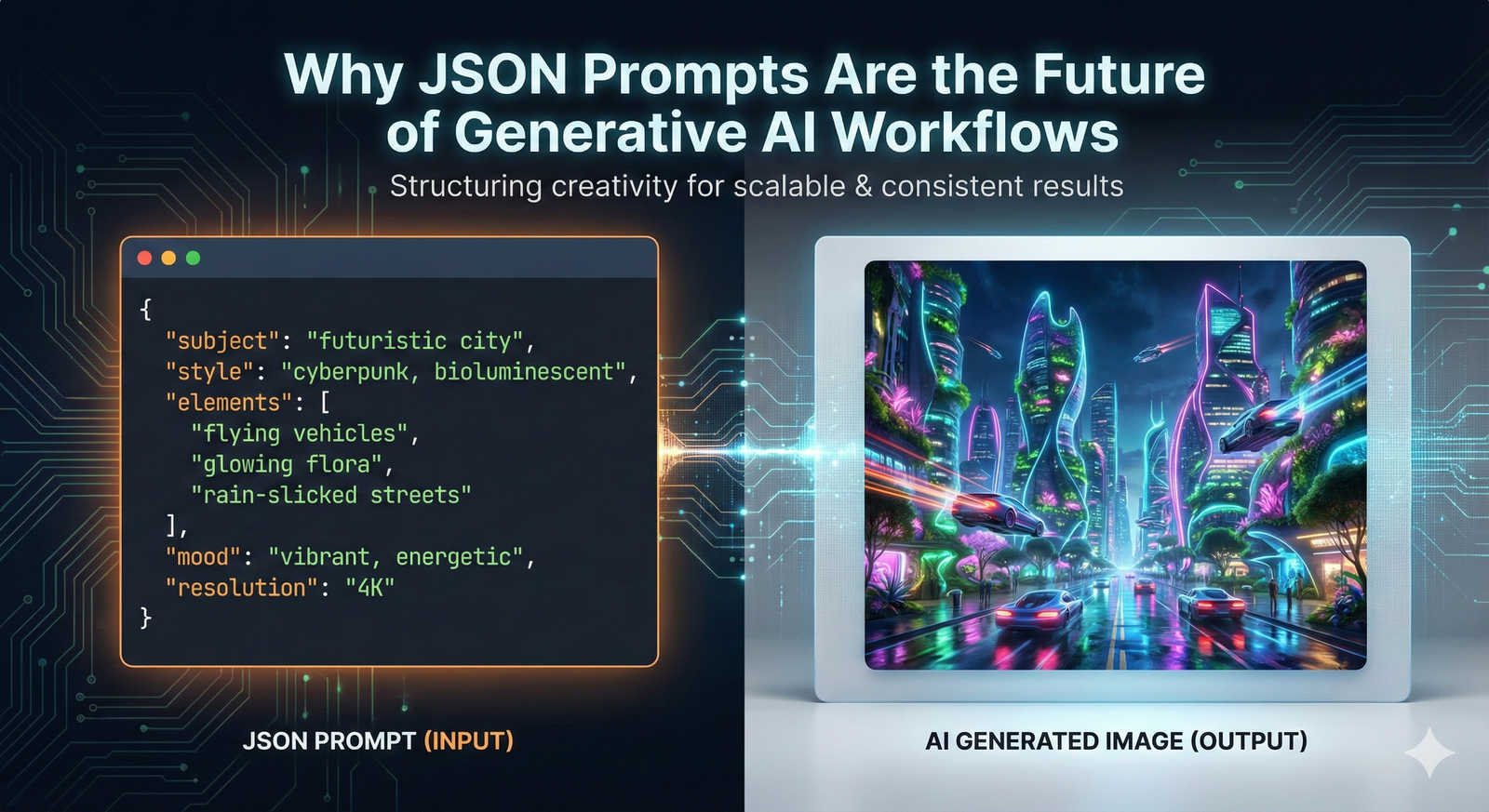
Why JSON Prompts Are the Future of Generative AI Workflows: The Shift from Text to Data
The revolution of generative Artificial Intelligence has been defined by the simplicity of the text prompt. From a single sentence, we can conjure images, write code, and summarize complex documents. However, as generative AI moves from a creative novelty to the backbone of enterprise operations, the limitations of unstructured text are becoming glaringly apparent. The future of reliable, scalable, and automated AI lies not in better prose, but in better data structures.
JSON prompts—or more broadly, structured data for generative AI—represent the next great leap in AI prompt engineering. This shift transforms the relationship between human and machine from a conversational exchange into a precise, programmatic contract. For developers, data scientists, and enterprises seeking to integrate AI into mission-critical workflows, adopting a structured prompting approach is no longer optional; it is the essential foundation for reliability and scale.
The Inherent Fragility of Unstructured Prompts
The core challenge with traditional, natural language prompts is their inherent ambiguity. Large Language Models (LLMs) and image generators are trained on vast, unstructured datasets, making them excellent at interpretation but poor at guaranteed output formats.
The Problem of Consistency
In a conversational setting, variability is charming. In a production environment, it is catastrophic. When a developer needs an LLM to return a list of customer names, a slight variation in the prompt—or even a change in the model's internal state—can lead to an output that is a bulleted list one day and a comma-separated string the next.
This lack of consistency forces developers to build brittle, post-processing layers to parse the AI's output, adding complexity and introducing points of failure. For generative image models, this ambiguity manifests as unpredictable style shifts, inconsistent character features, or a failure to correctly apply technical parameters.
The Problem of Context and Control
Natural language is an inefficient medium for conveying complex, multi-dimensional instructions. To direct an image model, a user must string together concepts like lighting, composition, subject, and style into a single, long sentence. This method is prone to:
- Prompt Overload: The model struggles to prioritize elements in a long, dense prompt.
- Syntax Errors: For models like Midjourney, forgetting a single parameter like
--ar 16:9can derail the entire result. - Lack of Reusability: A prompt written for one task is rarely reusable for another without significant manual editing.
JSON Prompts: A Programmatic Contract with the AI
JSON (JavaScript Object Notation) is the universal language of data exchange in modern software development. By wrapping the prompt's instructions within a JSON object, we provide the AI with a precise, unambiguous data structure, effectively turning the generative model into a reliable API endpoint.
2.1. Defining the Schema: The Blueprint for Reliability
The power of JSON prompts lies in the ability to define a schema—a blueprint that dictates the exact structure and data types the AI must adhere to. This is the programmatic contract that eliminates ambiguity.
For an image generation task, the schema might look like this:
{
  "type": "object",
  "properties": {
    "subject": {"type": "string", "description": "The main focus of the image."},
    "lighting": {"type": "string", "enum": ["Rembrandt", "Golden Hour", "Studio"]},
    "composition": {"type": "string", "enum": ["Rule of Thirds", "Macro", "Wide Angle"]},
    "technical_parameters": {"type": "array", "items": {"type": "string"}}
  },
  "required": ["subject", "lighting", "composition"]
}
When the AI is instructed to return an output that conforms to this schema, it is forced to operate within defined constraints, dramatically increasing the reliability and predictability of the output.
2.2. The Shift from Interpretation to Execution
This structured approach fundamentally changes the AI's role. Instead of asking the AI to interpret a vague request, we are asking it to execute a precise data command. This is particularly crucial for:
- Data Extraction: Converting unstructured text (e.g., a customer review) into structured data (e.g.,
{"sentiment": "positive", "product_id": "XYZ"}). - Code Generation: Ensuring the generated code snippet is wrapped in a valid JSON object, making it instantly parsable by a developer's toolchain.
- Image Generation: Guaranteeing that all necessary technical parameters (like aspect ratio, style, and model version) are present and correctly formatted, which is the core function of the Puretools AI Prompt Generator.
3. The Enterprise Imperative: Automation and Scalability
The true value of JSON prompts is unlocked in enterprise AI adoption and workflow automation. When AI is used for internal processes, it must integrate seamlessly with existing software, databases, and APIs.
3.1. Seamless Integration into Automated Workflows
In a modern enterprise, data flows through a chain of systems: a customer request triggers a ticket, which triggers a data query, which triggers an AI response, which updates a database. If the AI response is a clean JSON object, it can be consumed instantly by the next system in the chain.
| Workflow Step | Traditional Prompt (Unstructured) | JSON Prompt (Structured) |
|---|---|---|
| Input | "Summarize the key points and list the next steps." | {"task": "summarize", "output_format": "json", "fields": ["summary", "next_steps"]} |
| AI Output | A paragraph summary followed by a bulleted list. | {"summary": "...", "next_steps": ["Step 1", "Step 2"]} |
| Automation | Requires a complex, error-prone parser to extract the summary and steps. | Zero parsing required. The data is instantly ready to update a CRM or project management tool. |
This reliability is the difference between a proof-of-concept and a production-ready, scalable solution.
3.2. Building the Enterprise Prompt Library
For large organizations, maintaining a consistent brand voice, legal compliance, and technical standard across thousands of employees using AI is a major challenge. Structured prompting provides the solution:
- Standardization: The enterprise can define a set of approved JSON schemas for common tasks (e.g., "Marketing Copy Generation," "Legal Document Summary").
- Version Control: These schemas can be version-controlled and managed like any other piece of code, ensuring that every prompt used across the organization adheres to the latest best practices.
- Security: By limiting the AI's output to a defined schema, the risk of the model "hallucinating" or injecting malicious code into the output is significantly reduced.
4. The Role of Puretools in the Structured Prompting Revolution
While the concept of structured data for generative AI is technically sound, manually writing complex JSON schemas for every creative task is impractical for the average user. This is the critical gap that the Puretools AI Prompt Generator is designed to fill.
Puretools acts as the intuitive, user-friendly interface for the complex world of JSON prompts.
4.1. Translating Creativity into Code
The user interacts with a simple, guided interface, selecting options like "Cinematic Lighting," "Rule of Thirds," and "Midjourney V7.1." Puretools then translates these creative choices into a precise, technical JSON object that is guaranteed to contain all the necessary parameters.
User Input (Creative):
- Subject: A lone astronaut on a red planet.
- Lighting: Dramatic Rim Light.
- Composition: Wide Angle.
Puretools Output (Programmatic):
{
  "model": "Midjourney V7.1",
  "subject": "A lone astronaut on a red planet",
  "lighting": "Dramatic Rim Light",
  "composition": "Wide Angle (Establishing)",
  "technical_parameters": ["--ar 16:9", "--style raw"]
}
This output can be used in two ways:
- As a Prompt: The user can copy the resulting text prompt (derived from the JSON) directly into Midjourney.
- As Data: A developer can use the raw JSON object to feed into an automated image generation API.
4.2. The Future of Prompt Engineering is Hybrid
The future of AI prompt engineering is not purely text or purely JSON; it is a hybrid approach where the user provides the creative context, and the tool provides the structured data. Puretools empowers both the creative professional and the developer by offering both the human-readable prompt and the machine-readable JSON output.
Conclusion: Embracing the Data-Driven Future of AI
The transition from unstructured text to JSON prompts marks a maturation point for generative AI. It signifies the shift from a novelty technology to a reliable, industrial-grade tool. For any organization serious about workflow automation, consistency, and enterprise AI adoption, embracing structured data for generative AI is the only path forward.
Puretools is at the forefront of this revolution, providing the essential bridge between human creativity and programmatic precision. By translating your vision into a guaranteed, structured format, we ensure that your AI outputs are not just beautiful, but reliable, scalable, and ready for the future of automated workflows.
Ready to move beyond fragile text prompts?
Explore the Structured JSON Outputs feature on the Puretools platform and start building the reliable AI workflows of tomorrow.
Explore Puretools Features